{{ quickViewProduct.product_title }}
Stock ID
{{ quickViewProduct.product_stock_number }}
Product Features:
- {{ feature.product_feature_description }}
{{ option.product_option_title }}
{{ value.product_option_value_title }}
{{ quickViewProduct.product_stock_number }}
{{ value.product_option_value_title }}

 ()
()

Imagine not spending hours of your life sitting in traffic every year or circling the block looking for parking. How about having a trackable public transit system and hitting more green lights on your way home? If you've purchased a car in the last few years, your vehicle may have safety features like avoidance detection and adaptive cruise control. All of these useful technologies come to fruition with the help of Intelligent Transportation Systems (ITS).
Intelligent transportation systems, also called intelligent traffic systems, are devices and technologies that aim to make travel faster and more intuitive for the public. These systems are often designed to increase transportation safety and reduce congestion, among many other benefits, such as encouraging the use of public transit. An example of ITS would be electronic toll collection, where RFID scanning allows drivers to pass through tolls without stopping.
ITS is a critical component of the growing world of smart cities, as well as adapting to the changing needs for maintaining and improving transportation systems. ITS can even help tourism and entertainment applications by offering more attractive options and functionality. Let's take a closer look at ITS and what it means for cities across the globe.
ITS refers to the use of communications and information technology (IT) resources that offer solutions to traffic issues, such as congestion, accident prevention and violation monitoring. Many use the Internet of Things (IoT) to connect different devices to each other. Smart traffic systems using IoT may include everything from simple digital signs to complex systems that adjust intersection lights in response to nearby conditions and vehicles.
Due to their placement in such an important area — typically roads, interstates and intersections — with many associated safety risks, Intelligent Transportation System devices usually have to meet many codes and regulations for implementation. These requirements will vary from city to city.
ITS includes both hardware and software and manual and automatic processes. It covers several different ways of working with information. Some devices collect the data, others process it, and others share it or analyze it in some way. With the help of this technology, people and machines are better able to make informed decisions with powerful effects.
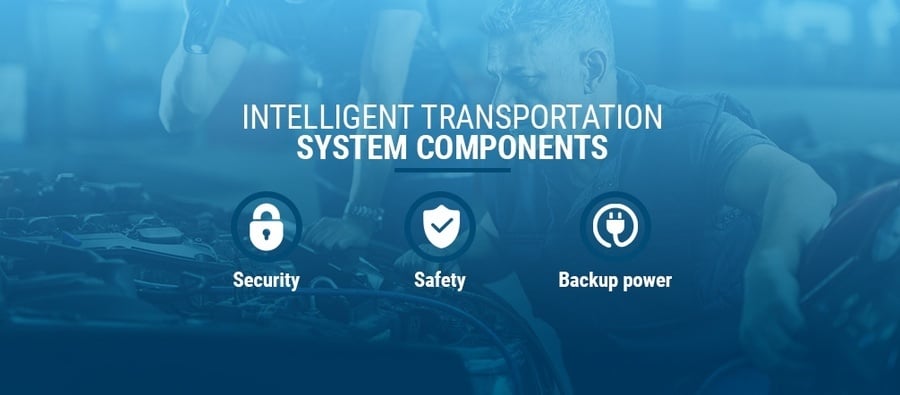
As mentioned, ITS covers a broad umbrella of tools and programs, each with different goals and components.
As far as general technical needs, ITS requires network infrastructures that can support its advanced functions. Often, ITS runs on hybrid networks that integrate existing hardware and wiring with these new technologies. This approach may require upgrades, such as fiber optic cabling, that can handle the higher bandwidth and power needs of advanced tech. Another method is to use industrial network switches or media converters to connect to the existing cables. Additions like this can help to improve connectivity and speed or allow for longer communication ranges.
Other significant technical requirements for ITS include safety, security and backup power:
It's helpful to note that some technology will affect your need for a UPS. For example, light-emitting diode (LED) lights consume less power than many other types, making them easier for a UPS to accommodate.
Speaking of applications, let's take a look at some categories of popular ITS devices.
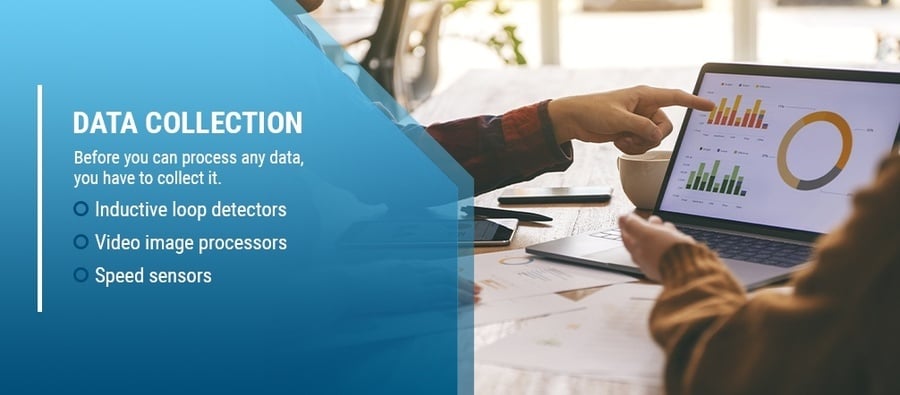
Before you can process any data, you have to collect it. This equipment often involves sensors, cameras and global positioning system (GPS) devices. They include the following.
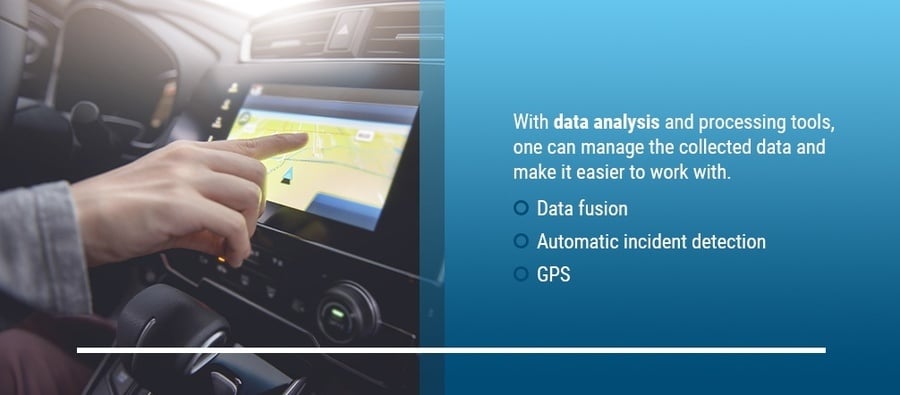
With data analysis and processing tools, one can manage the collected data and make it easier to work with. These tools can also eliminate the human element and help machines complete an entire task on their own, possibly reducing error or increasing speed in critical situations.
Some of the ITS devices and ideas that process data are as follows.
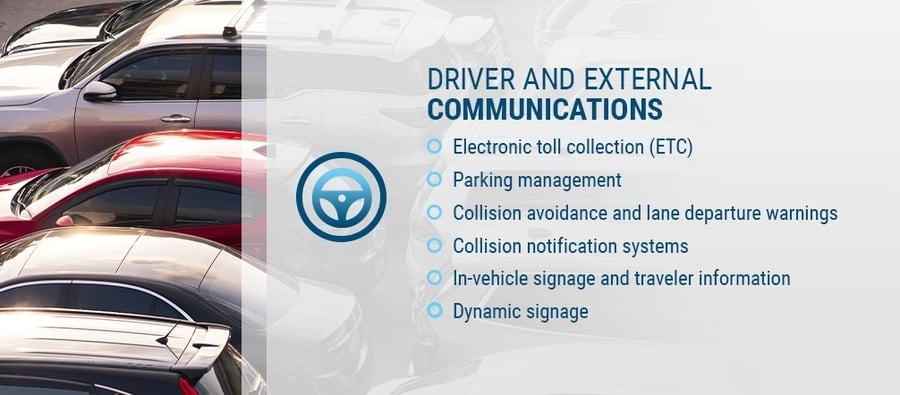
Since traffic involves the public and its understanding of road conditions, communicating with them is critical. Sending data to external entities is another task that often falls to ITS, with its fast transmission speeds and reliability.
Some technology that helps with data communication includes the following.
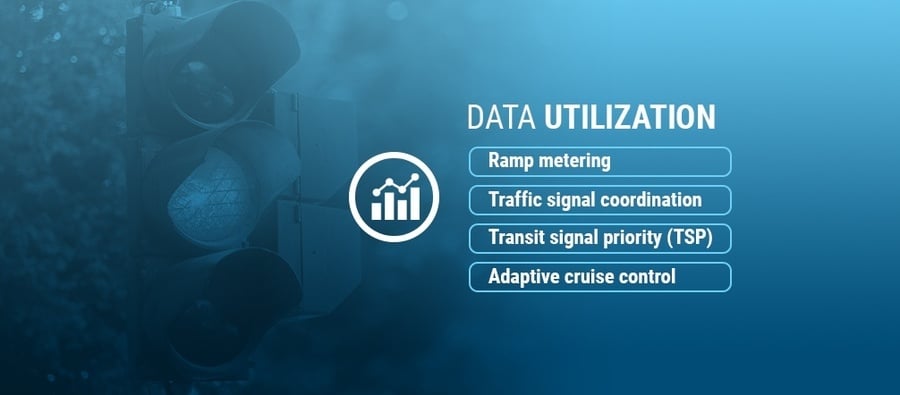
Collected data can inform a wide variety of other functions, such as the following.
You might wonder if Intelligent Transportation Systems use a fiber-optic network or something more traditional. Fiber optics are a critical part of modern ITS. As technology improves and advances, data speeds must advance with it. Fiber optic cabling is a modern, effective approach with high speeds and long-reaching coverage.
This lightning-fast solution helps different communication methods to operate in real time. Take incident detection, for example. If an event occurs, it may notify a control center, where an operator will need to move cameras around or call authorities. That kind of communication needs to be fast and respond to the changing situation quickly for maximum impact.
Fiber-optic cable has been replacing twisted copper and coaxial pairs for various transmissions formats. It can be particularly advantageous for video transmission. The most pressing applications are those where the data collection occurs at a distance from its storage or processing location, such as a traffic control system. Fiber optic's high bandwidth and signal immunity are better for traveling these long distances.
Another reason fiber optics come in handy is their future-proofing. In addition to speeding up existing tech, it can also help municipalities prepare for next-generation technology with the necessary equipment.
ITS developments have enabled various powerful technologies to make travel safer, faster and smarter for the public. Notable intelligent transportation system examples include:
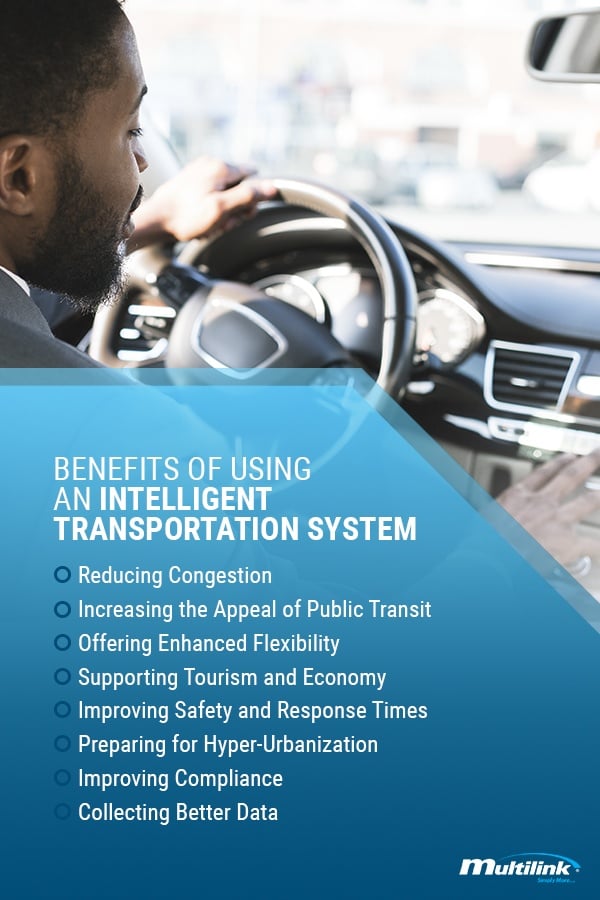
Using ITS offers many benefits across several different dimensions. The advantages of a smart traffic management system don't just apply to drivers, either — pedestrians, cyclists, public transit riders, governments, law enforcement agencies and the environment can also see its advantageous effects. The benefits of intelligent transport systems include various improvements to safety and public experience.
One of the clearest examples of ITS is its impact on your everyday traffic. As congestion clears, people can get to their destination in less time and with less frustration. Congestion is one of the most pressing issues in transportation, especially when you look at the numbers. Traffic management systems can cut travel times by as much as 25% by reducing congestion, offering significant time savings for commuters.
In reducing congestion, we can improve several of the most negative aspects of transportation. It minimizes environmental emissions and fossil fuel usage by allowing cars to spend less time on the road, using up less gasoline. It can also improve drive times, helping commuters get to where they need to be. A reduction in congestion can go a long way in making a city more enjoyable for drivers, whether residents or visitors, so it can also improve a city's image considerably.
Public transit doesn't always have a positive reputation. By making transportation more reliable and easy to use, such as through traffic light priority and GPS tracking systems, riders may be much more likely to hop on the bus to get to work.
A strong public transportation system helps reduce congestion and all the problems that come with it, such as fuel costs, environmental effects and long travel times. Plus, it can be cheaper for many riders when compared to owning and driving a car.
The wide array of technologies available makes it possible for cities to respond to the needs of their citizens in new ways. For example, say a city has many more drivers than pedestrians. If drivers become frustrated with wait times at intersections for walk signals that only accommodate a few pedestrians, a signal coordination system could be altered to extend the green-light time and cater more toward vehicles.
ITS has many levels of control that allow for customization and changes that fit the rapidly developing needs of cities and people. Intelligent transport system technologies are wide-reaching and can affect many areas of the modern commute and the general safety of streets and sidewalks.
Smart cities have a lot to brag about — they can make it easy for people to find parking spots, avoid traffic jams and get to their bus on time. With commute being such a big part of many people's lives, a city that can eliminate headaches associated with travel appears very attractive. It may be more appealing to move to or visit.
One of the main goals of ITS is to make the roads safer for everyone. Between in-vehicle safety features, automatic incident detection and fewer cars on the road in general, ITS can decrease the risk for accidents and help improve response times when they do occur.
As vehicle-to-vehicle (V2V) and vehicle-to-infrastructure (V2I) technologies continue to make great strides, the Intelligent Transportation Systems Joint Program Office conducted some research across different states, finding notable reductions in vehicle accidents. For example, in Indiana, queue warning trucks helped reduce hard braking events by 80%, lowering the likelihood of accidents.
With predictions like that, it's no wonder that auto manufacturers and cities are working hard to implement these technologies.
Today, more than 4 billion people live in urban areas worldwide, and that number has continued to climb in the last 10 years. More people in cities necessitate many new sustainable practices and technologies to manage their transportation habits. ITS can help with that and prepare cities for this growth.
With technologies like red light cameras and parking space occupancy detection, enforcement agencies can better respond to violations or prevent them in the first place. If people understand that their presence is automatically identified, as opposed to taking their chances with a ticket officer walking by, they may be less likely to try parking illegally in the first place. In this regard, ITS can even serve as a crime-prevention measure.
Since one of the benefits of intelligent transport systems is extensive data collection measures, such as the number and type of vehicles crossing a point each day, they can help cities make more informed choices. They may be able to offer more insights about the area and its citizens while informing improvements to infrastructure to match their needs. Cities can even use the data for things like the maintenance and upkeep of costly pieces of infrastructure.
You might wonder if Intelligent Transportation Systems use a fiber-optic network or something more traditional. Fiber optics are a critical part of modern ITS. As technology improves and advances, data speeds must advance with it. Fiber optic cabling is a modern, effective approach with high speeds and long-reaching coverage.
This lightning-fast solution helps different communication methods operate in real time. Take incident detection, for example. If an event occurs, it may notify a control center, where an operator will need to move cameras around or call authorities. That kind of communication needs to be fast and respond to the changing situation quickly for maximum impact.
Fiber-optic cable has been replacing twisted copper and coaxial pairs for various transmission formats. It can be particularly advantageous for video transmission. The most pressing applications are those where the data collection occurs at a distance from its storage or processing location, such as a traffic control system. Fiber optics' high bandwidth and signal immunity are better for traveling these long distances.
Another reason fiber optics come in handy is their future-proofing. In addition to speeding up existing tech, it can also help municipalities prepare for next-generation technology with the necessary equipment.
If implementing ITS is on your radar, you'll need the right tools for the job. Here at Multilink, our fiber optics will continue to be essential components of intelligent transport systems. Intelligent transportation systems work with the help of our fiber optic systems built for every need, from connectivity to splicing. Additionally, we offer UPS products and DOT traffic control cabinets to help you meet all the requirements for ITS at an affordable cost. We can even help with setup, too.
Start managing ITS tools with high-speed data and long-rate connectivity with the help of the experts at Multilink. For more information on how Multilink can help your ITS goals, reach out to a team member today.
Back to Multilog


